
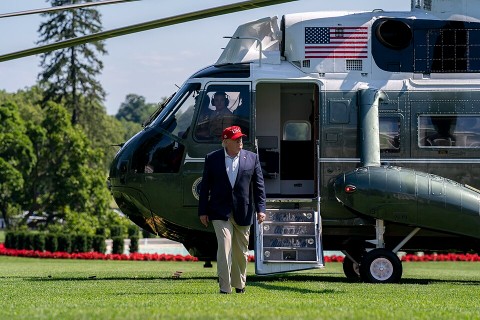
On Wednesday, former US President Donald Trump announced his intention to speak with Taiwan’s President Lai Ching-te, a move that could potentially strain US-China relations. Speaking to reporters at Joint Base Andrews in Maryland before boarding Air Force One, Trump stated, “I’ll speak to him,” indicating his willingness to engage with the Taiwanese leader. The prospect of this conversation is significant given the historical context; since Washington formally recognized Beijing over Taipei in 1979, direct communication between US and Taiwanese presidents has been rare. Notably, Trump previously broke diplomatic norms in 2016 as president-elect when he spoke with then-Taiwan President Tsai Ing-wen, prompting a formal complaint from China.
The potential call between Trump and Lai has yet to be scheduled. However, Taiwan’s foreign ministry expressed that President Lai would be pleased to converse with Trump. The situation highlights the delicate balance the US must maintain in its relations with China, which considers Taiwan a part of its territory and has not discounted the use of force to ensure control over the island. Historically, the US has supported Taiwan, including military aid, to deter Chinese military ambitions. Despite this, Trump’s administration has sent mixed signals, at times describing military sales to Taiwan as a “negotiating chip,” while also approving substantial arms deals with the island.
Trump’s remarks about speaking to Lai come just a week after a meeting with China’s leader Xi Jinping, dispelling rumors that his initial mention of the call was accidental. The ambiguity surrounding Trump’s stance on Taiwan is further complicated by his “amazing” relationship with Xi. After a recent trip to Beijing, Trump is still undecided on a significant arms deal with Taiwan, valued at up to $14 billion, leading to uncertainty about the US’s ongoing commitment to the island’s defense.
China, in response to Trump’s wavering on the weapons sale, is reportedly delaying approval of a visit to China by Elbridge Colby, the Pentagon’s undersecretary of defense for policy. Beijing has indicated that approval is contingent on Trump’s decision regarding the arms deal. Any direct communication between the US and Taiwan typically provokes a strong reaction from China, which views such interactions as a challenge to its sovereignty claims.
Despite Trump’s unpredictable rhetoric, President Lai has expressed a commitment to maintaining stability across the Taiwan Strait, emphasizing that Taiwan seeks to preserve its democratic and free way of life. He highlighted that Taiwan’s people should not be seen as provocative for pursuing these values. The US, under its legal obligations, continues to support Taiwan’s defense capabilities, and both Republican and Democratic lawmakers have urged the continuation of arms sales. Taiwan remains a crucial partner for the US, being its fourth-largest trading partner, largely due to its export of advanced semiconductors that are vital to the global economy.