
As global democracies face increasing challenges to the international rules-based order, the European Union is exploring new strategic partnerships, notably proposing Canada as its first “associate member.” European Commission President Ursula von der Leyen has extended this invitation to Canada, aiming to deepen cooperation in critical sectors such as technology, defense, and energy. This proposal underscores the EU’s intention to bolster alliances on the global stage.
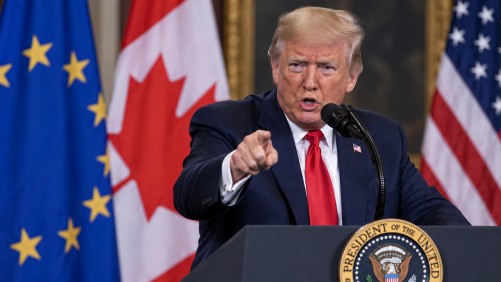
The potential EU-Canada arrangement, however, has drawn sharp criticism from U.S. President Donald Trump. He labeled the proposal as “laughable” and suggested it could be perceived as a “hostile act” against the United States. Trump warned that Washington might respond with heavy tariffs on European goods or reduce trade with the EU, contingent on the perceived intent of the move.
Canada and the EU already share a robust relationship, underpinned by a trade agreement and several bilateral arrangements. Their ties have grown stronger since Trump’s administration re-imposed tariffs on traditional U.S. trading partners, including both Canada and the EU. Von der Leyen’s proposal seeks to extend this partnership beyond trade, envisioning a comprehensive “alliance for the future” covering defense industries, artificial intelligence, critical minerals, and cybersecurity, among others.
In parallel, Canada is pursuing broader defense alliances, having formally applied to join the British-led Joint Expeditionary Force. This rapid-response military coalition includes ten NATO member states, reflecting Ottawa’s strategy to diversify its defense partnerships beyond its traditional reliance on the United States.
The details of what an EU associate membership for Canada would entail remain to be finalized, as the EU currently lacks a formal associate membership category. Nevertheless, countries like Norway, Iceland, and Switzerland maintain close economic ties with the EU, providing a potential model for future arrangements with Canada.