
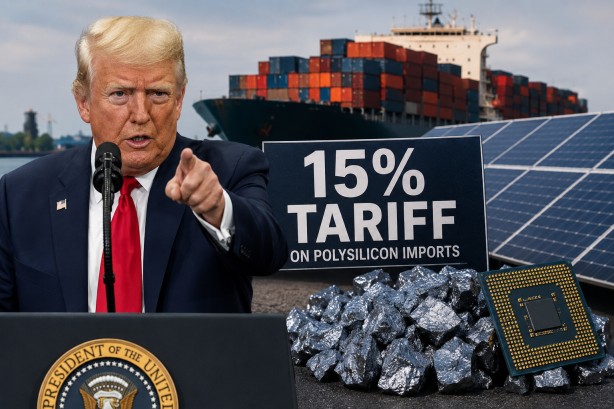
In a bid to bolster domestic manufacturing and decrease dependency on China, President Donald Trump has mandated a 15% tariff on imported goods composed of polysilicon. This tariff is set to commence on December 4 and targets a material integral to both semiconductor production and solar panel manufacturing. Polysilicon, a highly refined form of silicon, plays a crucial role in the creation of semiconductors that support artificial intelligence infrastructure and data centers, as well as solar cells. Currently, China dominates the global market in the production of this material.
The newly implemented tariffs also establish minimum import prices for various products: $21 per kilogram for polysilicon, $100 per kilogram for polysilicon ingots and wafers, $0.22 per watt for solar cells, and $0.38 per watt for solar modules and panels. According to the US administration, these measures aim to enhance the economic viability of domestic polysilicon manufacturing and to fortify supply chains that are vital for national and economic security.
China has responded critically to these tariffs, claiming that the United States is unjustly leveraging national security concerns to limit the operations of Chinese enterprises. The Chinese government has cautioned that such protective measures could potentially lead to trade disruptions between the two nations.
Currently, the United States hosts two main polysilicon production sites: one operated by Hemlock Semiconductor in Michigan and another by Wacker Chemie in Tennessee. In addition to imposing tariffs, the new policy framework also permits the US government to create incentives for companies that choose to invest in domestic polysilicon production and associated manufacturing facilities.
This tariff imposition occurs amidst China’s ongoing robust export growth, particularly in sectors such as electronics, artificial intelligence-related products, and other high-value manufacturing industries. By instituting these tariffs, the US seeks to strategically position its domestic manufacturing sector against the backdrop of China’s expanding influence in these critical technological arenas.